Director: Zach Cregger
Country: US
Writers: Zach Cregger, Shay Hatten
Actors: Austin Abrams, Paul Walter Hauser, Zach Cherry
Written by Tom Augustine
Zach Cregger pivots away from the weighty success of Weapons with this fleet, funny, nasty adaptation of the legendary video game franchise. By not taking itself too seriously, the film largely excels as a showcase for Cregger’s immense directorial talent, and provides a moment of movie-star arrival for lead Austin Abrams.
The movie biz of the moment is on a serious horror kick — anyone who has been to a sales market, follows festival buzz, checks in with box office prognosticators or knows someone attempting to break into the industry is aware that your best shot at getting something made is to retrofit it into a buzzy, low-budget, high-concept horror. That’s because the historical factors that make horror a young filmmaker’s game — a lack of need for major stars, an audience that will buy in on concept alone sans IP loyalty — are even more pronounced in 2026 where YouTubers have begun their transition from the digital platform to the big screen. Obsession and Backrooms are arguably the most successful films of the year, leveraging small budgets to enormous financial success. Beyond the realm of the financial, horror remains a major drawcard — masters of the genre enjoyed notable comebacks (e.g. Sam Raimi with Send Help), while beloved, under-the-radar franchises found critical acclaim (28 Years Later: The Bone Temple). Promising debuts abound, from Iron Lung to It Ends to Undertone to Australia’s Leviticus to Aotearoa’s own Mārama. There’s an international tenor to this, too: two of the best horror-adjacent films I’ve seen this year, South Korea’s Hope and Indonesia’s Ghost in the Cell, make no bones about being made outside the Hollywood establishment. There’s more to come, too: Other Mommy, starring Jessica Chastain, enjoyed a viral moment off the back of a batshit trailer, while Robert Eggers is unleashing another gloriously specific piece of historical horror with the forthcoming Werwulf.
As with Eggers, the directors who do find such horror success enjoy a fast-track to the big leagues: both Backrooms’ twenty-year-old wunderkind Kane Parsons and Obsession’s Curry Barker almost certainly have blank checks for their next few ventures. Among these many names, Zach Cregger holds rarefied air: he and his films overlap with many hallmarks of modern horror’s warped, unsettling visage — a comedy background a la Jordan Peele, a highly buzzed-about debut in Barbarian — but Cregger’s ambitions are greater and more serious-minded than many of his contemporaries, as demonstrated by the fascinating and deeply-flawed Weapons, a pseudo-Magnolia riff that saw its villain, played by Amy Madigan, vaunt to Oscar success earlier this year. Cregger’s ambitions often outpace his abilities, specifically as a writer — in every film, including his latest, he tends to bite off more than he can chew. That’s not the worst trait a filmmaker can possess — there’s value in a swing and a miss. And Cregger’s abilities as a director are deeply assured — few are able to generate the kind of giggly-tense anticipation of scares-to-come in quite the same way he does. These directorial abilities are on full-display in his charmingly unambitious video game adaptation of Resident Evil, a film whose marginal, tossed-off quality (ironically) ensures that it’s Cregger’s best and most accomplished work yet, while not escaping the clutches of the flaws recurrent in his other work. It aims lower than Weapons and Barbarian, less caught up on having something to say: a true double-edged sword, as Resident Evil goes down easy and lingers barely at all, but is such an enjoyable, fleet experience that such niggles can be ignored.
I must foreground this by saying that my experience of Resident Evil is close to nil: I never played the games, nor did I watch Paul W.S. Anderson’s equally maligned and beloved trash epic movie series that came to define the nu-metal era of noughties video game adaptations and made a star of Milla Jovovich. That said, this version of Resident Evil has already generated controversy among players in its less-than-devoted approach to the kind of lazy fan-service that has come to define modern intellectual property adaptations. You wouldn’t necessarily know that as a layman: Cregger’s Resident Evil has the feel of a video game experience, in the best sense possible — it moves at a frenetic pace, doesn’t get too caught up in ‘lore’, and places the audience in the driver’s seat (often literally, with the director’s repeated use of POV ‘gun-cam’ sequences of zombie carnage). It’s testament to the kind of work that can be made when a filmmaker relaxes on the auteurist throttle — with less of a tether between the work and the expectation that it stands in for the filmmaker’s entire ethos and worldview, the easier it can breathe as its own vehicle, making for one of the better ‘video game movies’ that I’ve seen.
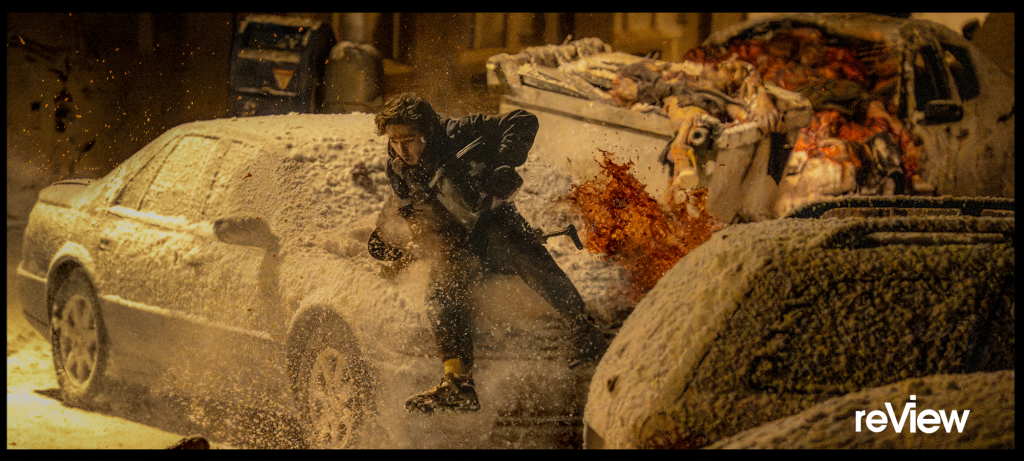
The film follows Bryan, played by rising star Austin Abrams, a standout of Weapons, and soon to be swallowed by a whale in the aptly-titled Whalefall. Bryan’s a bit of a deadbeat, a late-night courier who does organ dropoffs between DoorDash orders. On the fateful, snowbound night in question, Bryan is given an organ bag and told to drop it off in Raccoon City, the site of much of Resident Evil’s action, for a patient that needs it. Needless to say, along the way he is waylaid — beginning when he accidentally runs over a woman wandering a dark, icy road in the middle of nowhere, only to find she is one of the ‘infected’ who are running amok in Raccoon City care of the meddling of the scientists at the shadowy Umbrella Corporation. Those infected are somewhere between zombies and mutants, ravaged by a virus with a mind of its own and a habit of fusing bodies together into eldritch creations beyond imagining. As Bryan learns in real-time the scope of the disaster unfolding, we are right alongside him as he barrels from one terrifying situation to the next by the skin of his teeth.
Rather than winking at fans of Resident Evil, per se, Cregger instead winks to the wider audience of ‘those who have played a video game’ as Resident Evil unfolds. There’s numerous clever nods to the bizarre internal logic of the video game concept — as Bryan descends toward Raccoon City central, he comes across increasingly bigger and more impressive weapons, discarding the ones that have come before, and is faced with puzzles of architectural logic that he must solve under pressure to escape the hordes chasing him. This works because of the gleeful, liberated sense of fun to be had, and the committed work of Abrams, who makes a star of himself in the way he endears us toward full investment in his journey. Abrams has something of Bruce Campbell about him, fitting for a film that feels close in tone to Evil Dead 2, with its delirious mix of electric scares and absurd comedy. It’s a performance so good that it ultimately threatens Cregger’s evident desire for a high-caloric, low-investment horror romp: the film’s frantic momentum never lets up, but eventually runs out of steam, and the protagonist is the ultimate casualty.
As with Barbarian and Weapons, Cregger’s latest opens far better than it ends, with the final resting place feeling unfitting considering all that’s come before. The early sequences are remarkable for their bait-and-switch tension and directorial control — an extended scene taking place at an abandoned(ish) farmhouse features some of the most assured and satisfying jump-scares of any film in recent memory, utilising space, editing, sound and subversion of expectation to terrifying ends. But the film’s lamentable decision in the late stages to divert away from Bryan’s perspective to ancillary, uninteresting characters lessens the overall impact. The final act of Resident Evil also locates a chemical imbalance that the rest of the film has kept at bay. Where the film’s first and second acts feature recurring gags and sudden dashes of comedy that lighten the load and keep us rolling along merrily, the film’s final act delves deep into the cartoonish, and underestimates our commitment to Bryan’s character, landing somewhere closer to the Fallout television series than anything that has come prior. It is a film of set-pieces, and there are enough here to ensure that we leave on a high despite an underwhelming denouement — but the knowledge of Cregger’s underinvestment in the property reminds us that where we arrive is likely the final resting place for this particular storyline, a realisation that can’t help but leave us wanting more.
Resident Evil opens in NZ cinemas 17 September.