

RATING
Director: Ken Russell
Country: UK
Writer: Ken Russell, John Whiting, Aldous Huxley
Actors: Vanessa Redgrave, Oliver Reed, Dudley Sutton
Written by Tom Augustine
The movie event of the year is a thought-lost masterwork from decades past, restored to its proper length and presented with pristine clarity. The Devils, Ken Russell’s most infamous and provocative work, is a fearless, rapturous experience that puts much of modern cinema to shame.
For those of us raised Catholic — as I was — repression, guilt and doubt are undercurrents that roil under the surface constantly. The impacts of this upbringing are hard to pin down, but you can spot a fellow lapsed member from miles away. It is not as though my family were especially devout. My grandparents certainly were, attending church multiple times a week. Me, my sister and my mother were submarine Catholics, only surfacing once or twice a year, with brief periods of more intensive presence when my mother became the principal of a Catholic school that my sister attended, and during my introspective religious phase in my early teens, after which I quickly realised that the confines of organised religion didn’t do it for me. Still, there is a lingering love and affection for Catholicism, for its pomp and circumstance, its ceremony and self-seriousness. I can’t speak for other religions, but a torturous uncertainty about the whole thing feels genuinely central to the Catholic faith — the link between our awareness that we are terrible sinners, and our doubts about how best to deal with that, are intricately linked to the practice of Catholicism itself. This anxiety is reassuring, in its own way: we are fallible, flawed beings, sinners all, and loved regardless. Perhaps this doubt is linked also to our awareness of the many evils of the Catholic church over the centuries, something which the last two Popes seem surprisingly conscious of in the way they address the problems of the modern world. To be Catholic is to march forward with the knowledge that this system built to worship God is all-too-easily manipulated, and perhaps ultimately untenable on a societal level. Though I no longer consider myself a Catholic, I cannot deny the teachings shaped my moral compass, and I maintain an admiration for these recent Popes whose clarity in uncertain times around many (not all, to be clear) pressing issues is quite remarkable.
The Devils is the story of a perfect Catholic — a profoundly imperfect man whose suffering delivers him to paradise. Ken Russell, the provocative and iconoclastic British auteur, declared that he had lived his life as a devout Catholic before his death in 2011. Though The Devils, which wrestles with faith in some of the most extreme ways ever put to screen, was roundly (and unsurprisingly) rejected by the Vatican, and decried broadly as sacrilege, those who have struggled with their faith, as I have, will recognise the genuine love for the faith rumbling beneath the hysteria, blasphemy and pain. It is the same struggle present in other great Catholic filmmakers like Martin Scorsese, who endured his own trials in the release of The Last Temptation of Christ and Kundun, before summing up his religious beliefs in late-career classic Silence. Robert Bresson, the polar opposite of the flamboyant, maximalist Russell, commonly thought of as cinema’s ‘high priest’, nevertheless bears many thematic similarities in the agony and despair present in Diary of a Country Priest, Pickpocket, Au Hasard Balthasar and others. Russell’s most direct corollary may indeed be someone like Caravaggio: both deeply flawed geniuses whose work is similarly concerned with agony and ecstasy, and who riskily challenged traditional sensibilities.
What is perhaps most surprising about The Devils, then, is that Russell himself considered it a political text first, and a religious text second. Adapted from John Whiting’s play and Aldous Huxley’s non-fiction novel about true events in the fortified town of Loudun in France in the 17th Century, when a prominent priest was accused of witchcraft and heresy and executed by burning at the stake, Russell’s The Devils is one of the most heavily, famously censored films in cinema history. The director’s vision of the film did not exist publicly until the early 2000s, screened only once. Versions circulated that were heavily edited, with the guts taken out, and only in low quality, for decades. It was banned in several countries upon its release in 1971, and the versions seen in the UK and US excised roughly eight minutes of footage, much of which Russell considered to be the best work of his career. Most extreme is the ‘Rape of Christ’ sequence, in which naked and hysterical nuns pleasure themselves on the figure of Christ on the cross, while a priest masturbates from afar. Its removal is a travesty — as Russell argued, it is the soul of the picture, a damning and nightmarish literalisation of the madness of groupthink, fuelled by the manipulation of religious doctrine. After it played to a packed audience at the Hollywood Avondale last night, the crowd burst into spontaneous applause, so radical and unique a sequence it is to witness in the cinema.
The other travesty of The Devils is that this director’s cut is only now being released, more than a decade after Russell’s death and more than five decades after the initial cut arrived on screens. It was imprisoned, much like the film’s manic Sister Jeanne (Vanessa Redgrave), in the Warner Bros. vault, attaining Holy Grail status in the process — a mythical cut that many believed would never be seen again. That Russell is not alive to see this pristine restoration, surely the most significant of its type in years, and the surrounding hype that bubbles around it, is a great shame. One imagines it might have felt like finding peace for this brave and unapologetic artist. The film is released by Warner Bros. new arthouse label Clockwork, seemingly designed to compete with the likes of A24 and Neon ahead of the company’s merging with Paramount Pictures. That a film about, per key Russell champion Mark Kermode, ‘a despotic tyrant with stupid hair, using religion to oppress the masses, to whip up hysteria, to cause destruction, to enrich himself’ would be released by a company about to merge with a very notable Trump supporter’s empire, is a great joke: one imagines that such a release simply would not happen a few months from now when the companies finally, completely meld.
Kermode famously promised Russell that his vision would be taken in by the masses someday — the version here achieved in 4K is nothing short of astonishing. As director Guillermo Del Toro said, to watch The Devils in 2026 is to see it anew. The images burst off the screen with elemental force, their beauty primed to overwhelm even the most cynical of audiences. It is, ultimately, a film about three people: Sister Jeanne, whose role as the abbess of the Ursuline convent of Loudun (a sect of women whose devotion to God requires they be shut off from the world entirely) leads to one of the most severe cases of sexual mania ever documented, coming on like a demonic possession; the nobly ignoble Urbain Grandier (Oliver Reed), whose dashing authoritativeness holds every woman (and man) in his orbit in thrall; and Madeleine (Gemma Jones) the chaste, comparatively ordinary young woman who lays claim to loverboy Grandier’s heart. Only ever witnessing Grandier from afar, Jeanne is plagued by erotic and terrible visions of Grandier as the returning Christ, and she his lover — one of the film’s most striking scenes sees the hunchbacked Jeanne, her long red hair released from the confines of a habit, licking the wound of Christ come down from the cross, who has taken on the figure of Grandier. When Jeanne learns of Grandier’s secret marriage to Madeleine, her jealousy prompts her to inadvertently accuse Grandier of witchcraft and possession, concocting a fantasy of demonic rape that the institutional powers-that-be, desperate to remove the influential Grandier from power due to his allegiance to the people of Loudun (whom they wish to subjugate), utilise to whip up religious hysteria that the Devil himself is in their midst, masked as a priest.
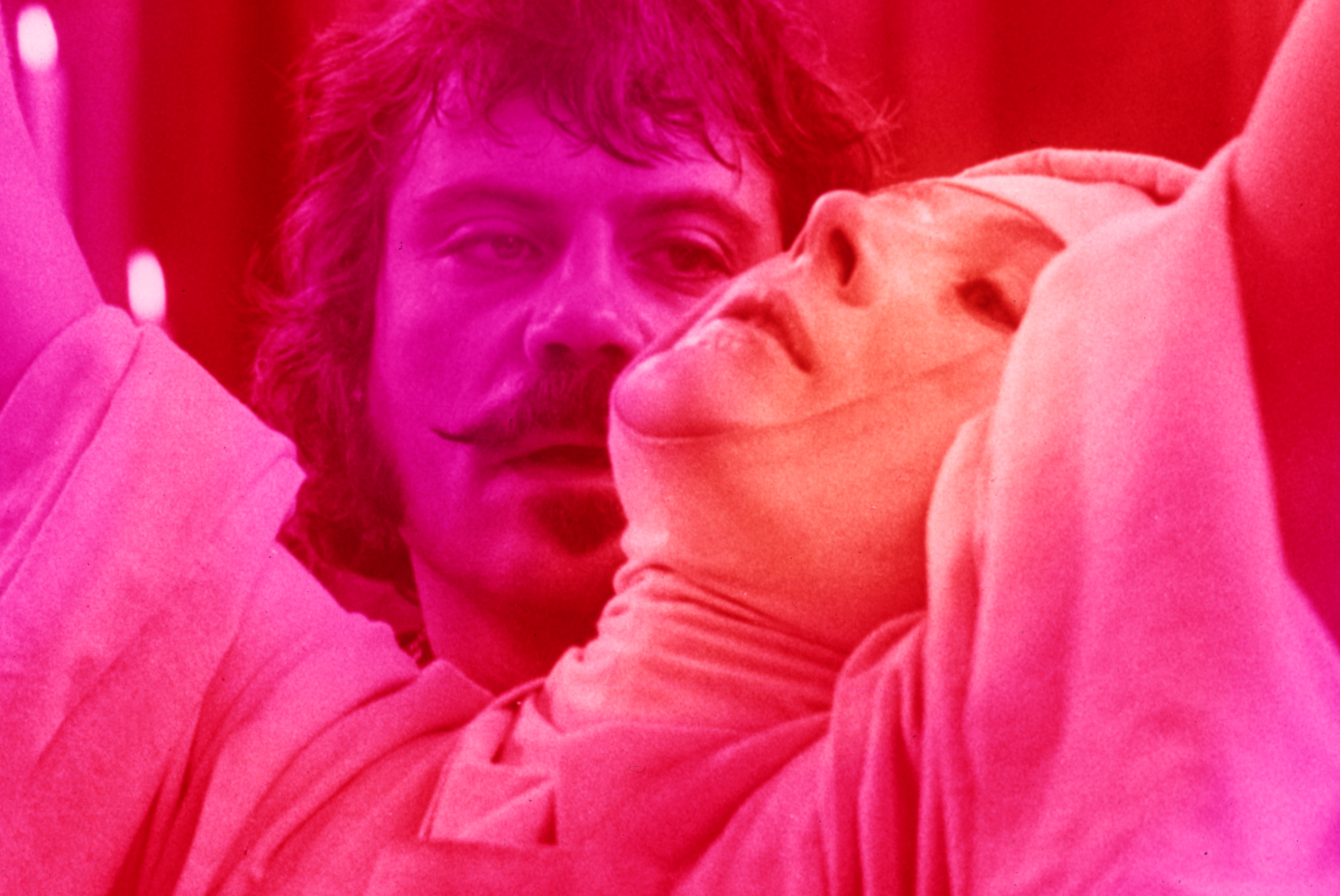
What follows is an escalation of terrifying force, ramping up from the film’s hilarious and lush first act to sequences of shattering intensity. The exquisite performances ensure the film’s nearly cartoonish operatics never overexert themselves — Redgrave’s turn is profoundly unsettling, riveting us to the screen, Jeanne’s uncontrollable paroxysms the source of much of the film’s uncomfortable humour, and later horror. Russell’s film certainly has a feminist reading, the suffering of Jeanne on the same level of Grandier, with the fact that she’s left alive by the end of the film the greatest punishment of all. Reed, meanwhile, as Grandier, delivers one of the great male performances in cinema. He’s a total cad, vain and self-centered, and those human flaws are the very source of his salvation. He is no better than his subjects — though he enjoys his power over them — but at heart his relationship to God is pure and his self-awareness is his saving grace. Barrel-chested and moustachioed, his is the performance one will likely remember, echoing the trials of Joan of Arc, the unbearably human heart at the centre of the maelstrom. Around these figures, innumerable unforgettable bit parts swirl. As the hilariously buff, rockstar-like Father Barre, the lead inquisitor, Michael Gothard cuts a raucous figure, his insecurity fuelling his every movement, while Murray Melvin as an underling wrestling with his own crisis of conscience is one of the more striking visages within the ensemble.
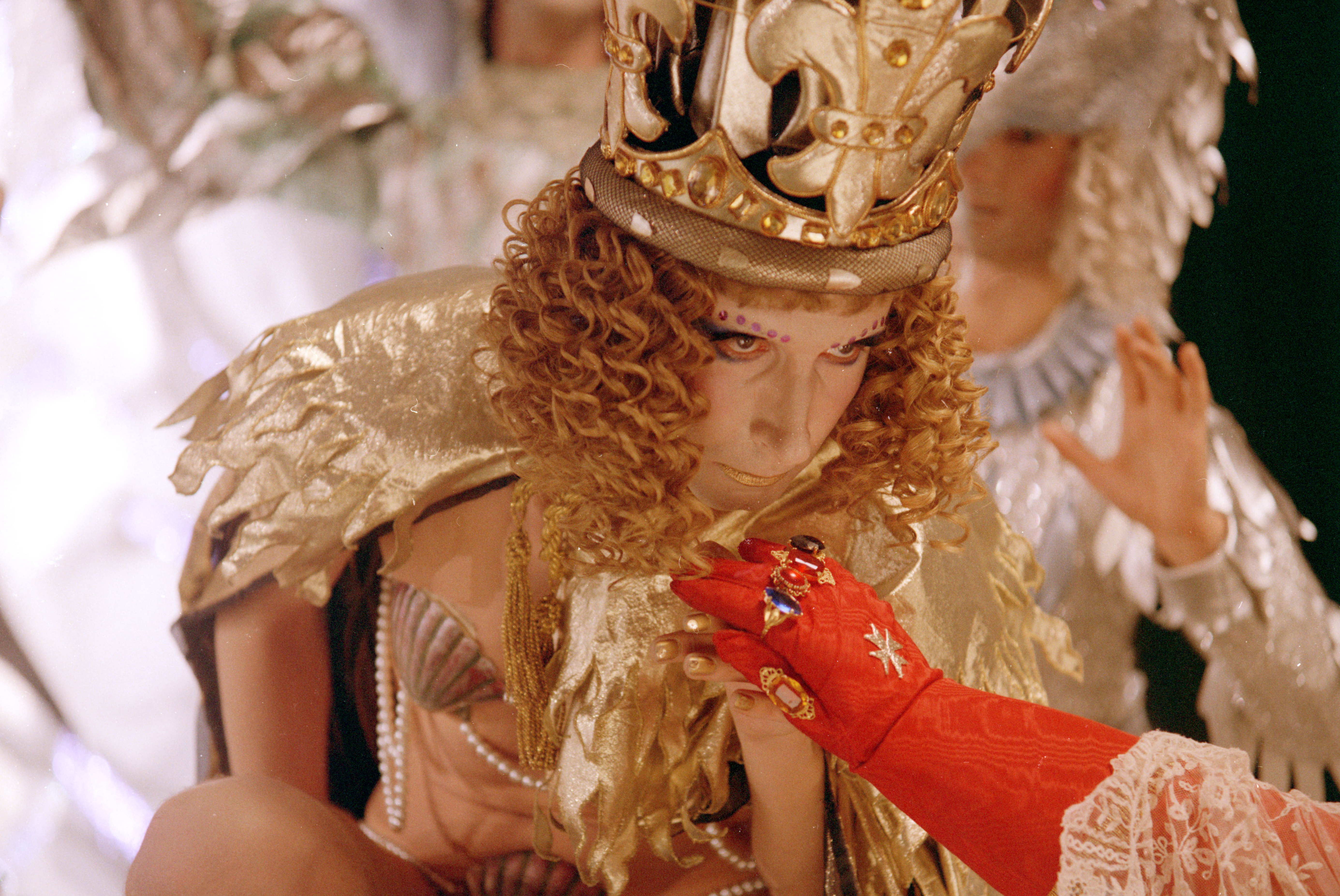
Russell’s directorial skill, flexed here in all its raw glory, is beyond reproach — the scale and breadth of the images, and Russell’s control of them, reminding us of the persuasive powers of a true master of their craft. It is fair to say that the superlative work of the many artists involved is a stark reminder of just how few films ascend to this level, particularly in 2026. Placing The Devils alongside even the very best of this year is a contrast that few modern films can withstand. It was not Russell’s contributions alone that ensured this — David Watkin, the renowned cinematographer, constructs Russell’s semi-Kubrickian images with apparent ease, while the great filmmaker and artist Derek Jarman’s immaculate set design is some of the finest in cinema history. Shirley Ann Russell, the costume designer (and one-time wife of Ken) strikes the perfect balance between anachronism and fealty to the era — Barre’s tinted, Warhol-esque spectacles a particular highlight. The film’s music, by Peter Maxwell Davies, performed by chamber piece ensemble Fires of London, strikes a balance between carnivalesque bombast and suggestive, psychologically upsetting tonal inflections. The restoration, decades divorced from the original print, brings forth the rich colours and strong lines that previous, low-quality versions kept frustratingly at bay. The Devils is, undoubtedly, the movie event of the year, a rare treasure that enriches, horrifies and emboldens all who see it. It is a film that drags us to the depths of blasphemous degradation, and in doing so, invites us to bear witness to the face of something holy waiting on the other side.
Ken Russell’s The Devils is now showing in selected cinemas.