



RATING
Director: Aaron Sorkin
Country: US
Writer: Aaron Sorkin
Actors: Jeremy Allen White, Mikey Madison, Jeremy Strong
Written by Tom Augustine
Alone without the presence of The Social Network’s star and director, original scribe Aaron Sorkin delivers a pale imitation of a masterpiece, a hamfisted play for the middlebrow that throws David Fincher’s scalpel-like incisiveness into sharp relief. Reckoning’s three buzzed-about performances are utterly stranded in a film of depressing staleness that sets in from the opening frames.
The Social Reckoning is an old man’s movie, much as Facebook is an old man’s social media platform. Once, Facebook was the centre of the universe, a parameter-shifting expansion of the potentialities of the internet in connecting and sharing our lives — that’s an idealised version of the story, but those who wished to accentuate the positive at the time could find ample evidence to back themselves up. It was about that same time that Aaron Sorkin’s writing felt fresh, vibrant, on-the-button: 2010’s The Social Network, one of the finest films of the 21st Century, met the social media generation where they were, constructing a sleek, menacing frat boy epic in which no significant character was aged above thirty. Now, Facebook is the banner carrier of an era of enshittification — clogged with ads, misinformation and AI slop, a pale shadow of what once was and patient zero for any number of the internet-led societal ills with which we now grapple. The same can be said of Sorkin, at sixty-five, returning to the site of his crowning achievement sans David Fincher, whose exacting style located the insight in Sorkin’s bombast, and Jesse Eisenberg, who embodied Facebook mastermind Mark Zuckerberg with a magnetic roboticism that simultaneously humanised the youngest-ever billionaire, and divorced him entirely from the world around him.
Like many of the greatest films, the power of The Social Network lies in its ability to transcend what we know about the subject matter, and the people who made it. That a film of such withering, clear-eyed accuracy in targeting the entitlement and insecurity that has fueled our modern-day technocracy could come from the likes of a writer who, for all his merits at different stages of his career, never counted ‘self-awareness’ among them, is remarkable. And yet, here is a film, from a writer often derided for his writing of women, where misogyny thrums at the very core, the driving force for soul-destruction on the part of its young, ambitious tech-auteurs. The Social Network continues to feel fresh — its depiction of the hellscape that is the American fraternity, and the intensity with which young men pursue them, ‘Because they’re exclusive. And fun. And they lead to a better life’, explains Zuckerberg as much as it explains the conditions that allowed for the ‘Cornell Seven’, as they have been so monikered. Beyond that, though, the film’s construction, via Fincher, managed to find something in Sorkin’s writing that it had never been before — youthful. Aided by Trent Reznor and Atticus Ross’ crystalline electronic score, Fincher leaned into Sorkin’s rattatat verbosity, speeding up his actors’ line-reads in a way that, at the time, felt challenging to keep pace alongside. I often consider Sorkin in the same way I consider Stephen King, a writer of a certain generation whose misty-eyed fealty to ‘American values’ feels hopelessly naive but which, when paired with the right filmmaker, can locate the thing under the thing: the senseless, contradictory horror that comes with unerring belief.
Sadly, The Social Reckoning offers no such outlet for Sorkin who, left to his own devices, has created a work hopeless in its inability to read the pulse of the population, a film of outrage and self-importance that earns neither. Part of the fatal sum here is that it is deliberately positioning itself as a sequel to a masterpiece, but utilises only a few elements that made the original recipe so stunning (Sorkin is here joined by Network’s cinematographer Jeff Cronenweth, the disparity between the two films’ styles as sure a demonstration of what a director does as any I can think of). In every way, Reckoning reaches for the peak that Network represents and fails to grasp it. Doing away with that film’s scalpel-sharp uncovering of Zuck’s interior impulses, Reckoning instead takes a wider, societal view, wrestling (sort of) with the world Facebook wrought, with Zuckerberg himself largely floating on the periphery. Instead, the key figure here is Frances Haugen, played by recent Oscar-winner Mikey Madison, the whistleblower who exposed Facebook’s intentional prioritising of profit over avoiding societal harms in a 2021 leak published in the Wall Street Journal by Jeff Horwitz, here played by Jeremy Allen White. The film jumps between their 2019 meetings, as Horwitz slowly works the information out of Haugen, and 2021, as Zuckerberg prepares for hearings as a ‘professional defendant’ arguing for his platform’s loyalty to the concept of free speech (read: misinformation and disinformation) on the eve of the January 6th storming of the US Capitol building by enraged neo-Nazi protestors.
Last week, I wrote about one of the best films of the year, the enervating and nightmarish Digger, a film that I haven’t been able to get out of my head since the moment its credits rolled. I gave it four stars in my review, but since then its esteem has only grown in my eyes. It is one of the few American films that I’ve seen that sincerely reckons with the relation of art and commerce under capitalism, and the limitations of what art can be and do when it is financed, distributed and controlled by the same powers oppressing the populace who consume them. It’s an idea summed up succinctly by another great artist delivering a surprising, alienating piece of work this year: ‘Nothing’s gonna save us, not music, fashion or film’. For the liberal, overarchingly earnest Sorkin, this is not a sentiment that lands, and thus The Social Reckoning feels out of touch from its opening title card, speaking to the moment only in the sense that it is yet another toothless and half-measured plea to decency in a nation that has long since cast such notions aside.
Sorkin has never felt older than he does here, in every respect: his dramaturgy is ambling, his direction obvious, his scripting alien in the mouths of his characters. It is nuance-free storytelling, intended mostly to enrage and appeal to the bleeding heart. Its climactic sequence, the aforementioned storming of the Capitol, is key in understanding this: for Sorkin, the Capitol remains a bastion of democracy, assaulted by turncoats who fundamentally disrespect the American Way, an atrocity for the ages. The reason the outrage is implied but never felt goes deeper than Sorkin himself feels capable of reckoning: in an era of Trump and Biden, sweeping poverty, climate change, opioid epidemics, corruption, mass shootings, ICE killings and kidnappings, the overturning of Roe V Wade, the enabling and involvement in genocide, the ceding to tech fascism, and endless other overlapping crises, the idea of America as a democracy has long since withered and died, its symbolic spaces revealed as the fantasies they always were. In this space, every victory is phyrric, including the end of The Social Reckoning itself, which strains desperately for a silver lining but can’t find anything but storm clouds. To put it in tech terms — the atrocity is the feature, not the bug.
Fantasy though it obviously is, that alone is not enough to render as damning an experience as The Social Reckoning turns out to be. It’s hard to believe that the same writer who delivered us The Social Network, Moneyball, even A Few Good Men could have so feeble a handle on how to tell this particular story, one in which he is well-versed. It is a film as much about a few good journalists as it is Facebook, but its interest in journalism is skin-deep and trite — Sorkin appears to be aiming for some sort of Capra-esque screwball interplay between Madison and Allen White’s characters, feinting at a will-they won’t-they, but the film’s bland, televisual aesthetic traps its actors, never allowing for genuine chemistry to ignite. Madison, so vivid in Anora, is utterly lost here in her all-important follow-up role, struggling to inject soulfulness into leaden, absurd character dynamics. Much has been made of Sorkin’s general inability to render women on-screen — it is arguably a central tenet of what makes The Social Network so fascinating — but there is no such nuance to be found here. Instead, her character is given only the barest of backstories: an abiding love for Facebook’s quoted mission and an inability to be ‘fun’ (cue groans). It is not helped by Sorkin’s leering and condescension throughout — one of the most staggering being an ongoing gag(?) in which Madison’s Haugen, whom we are repeatedly reminded is frumpy, largely sexless, dressing in revealing, ‘sexy’ clothing to meet Horwitz at his hotel for clandestine info-dumps, to allow her to utilise ‘hotel hookup’ as an alibi should she be caught. The costumes in question, some of the most garish and inelegant feints at allure I could conjure, feel entirely dredged from the psyche of a sixty-something male director. The less said about Horwitz’ arguments about ‘mansplaining’, following the lead of Sorkin’s dreadful The Newsroom by placing his opinions in the mouths of his actors, the better.
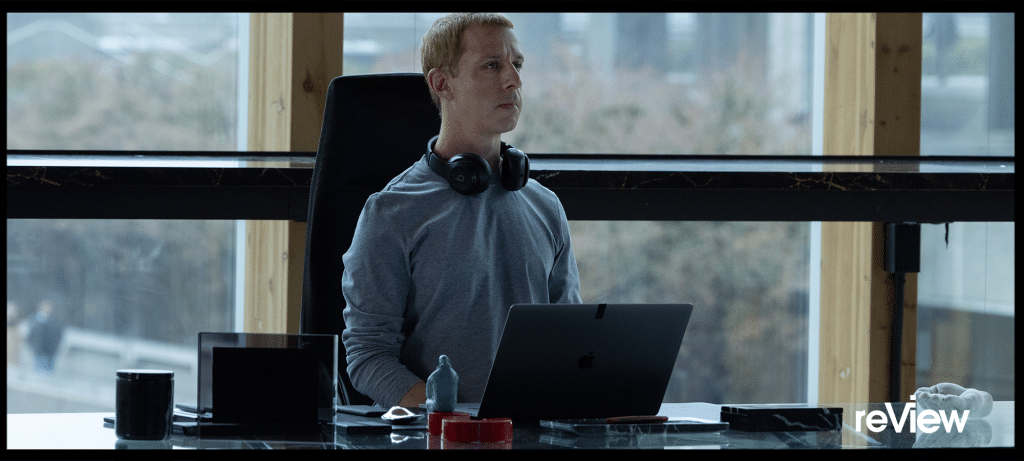
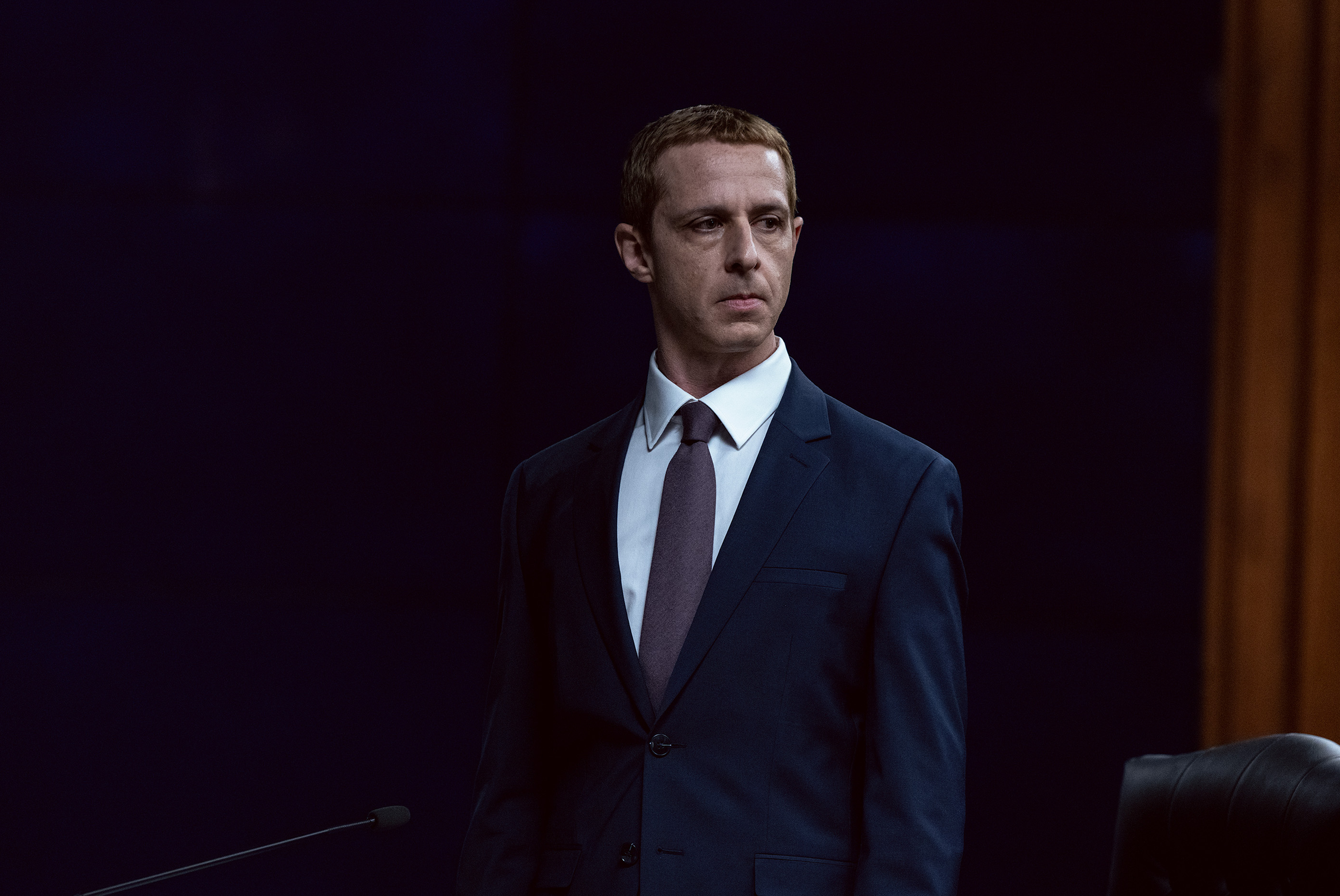
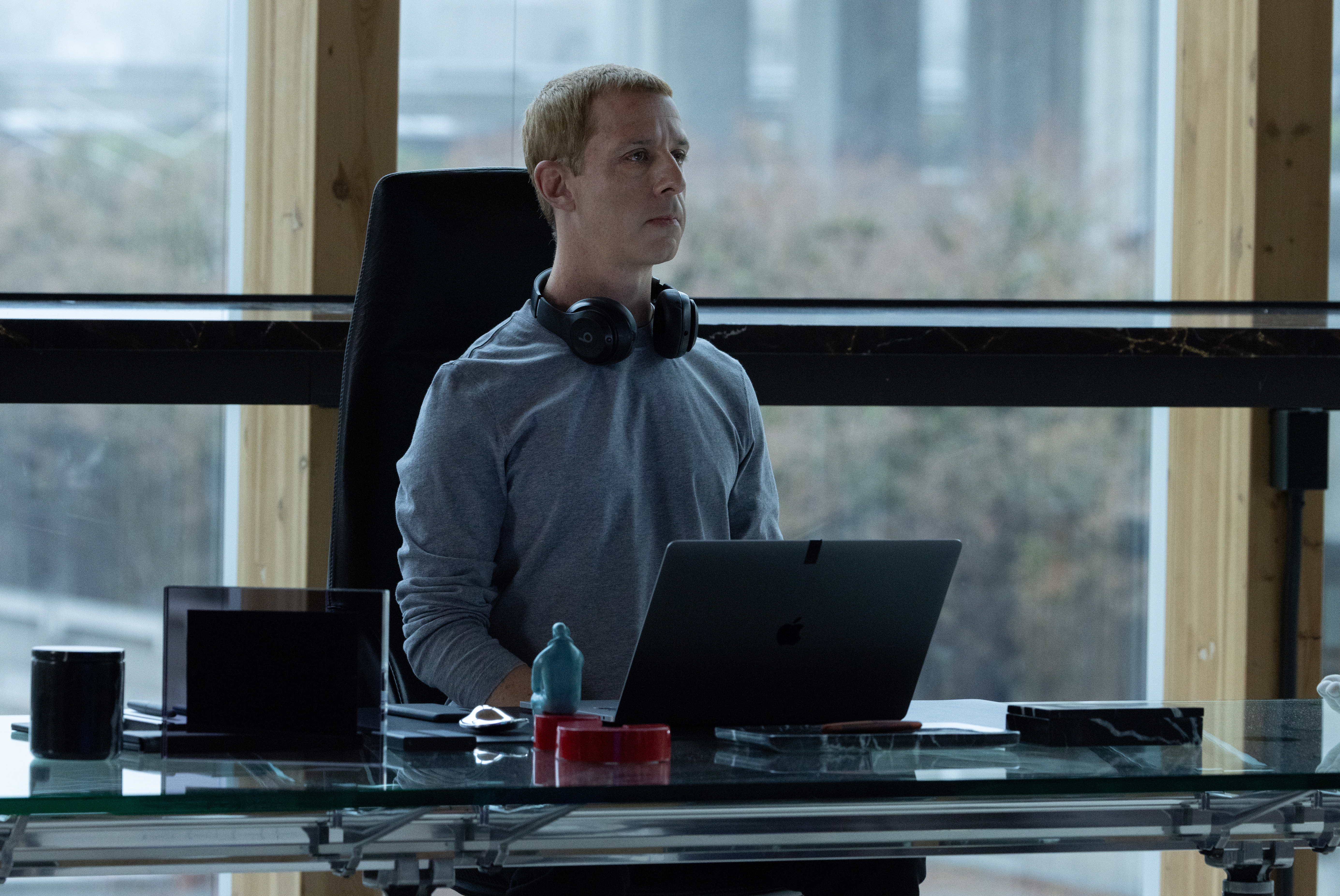
Then there is the Zuckerberg of it all, with Succession actor Jeremy Strong here taking the mantle from Eisenberg. Strong, a committed and talented actor, has a handle on Zuck’s mannerisms, and has found an interesting shade in which to play the technocrat. Occasionally, Strong will deliver a line with a facial expression that rings eerily true to Eisenberg’s characterisation, suggesting a man who has aged, but not changed — he is still sat behind that laptop, refreshing the page, as we left him at the end of Network. There’s something poetic and suggestive in that, but The Social Reckoning has no clue what to do with it. Is Zuck a third lead? Is he the villain? Is he the man behind the curtain? In the sections of the film that do not feature him, instead focusing on Horwitz and Haugen’s undercover operations, that third option feels like the surest (and best) bet. The more the character remains on the margins, a controlling but totally unknowable Colonel Kurtz at the end of the river, as most billionaires ultimately are, the better. But Sorkin lacks the confidence to commit to this, and so we are handed interminable sequences of Zuck practising for his court date or being told bad news — the more light is shone on him as a person, the less threatening he appears. Like the other actors, the intricacies of Strong’s accomplished attempts are all but lost in the process. The result is that The Social Reckoning just feels weary, past its use-by date on arrival. Facebook may have been Patient Zero, but the virus has ravaged us to the point that it is now just one facet, a single statistic in a long line of debts to be paid, one which artists like Sorkin continue to prove that they no longer have the tools to extract.
The Social Reckoning is now in cinemas.