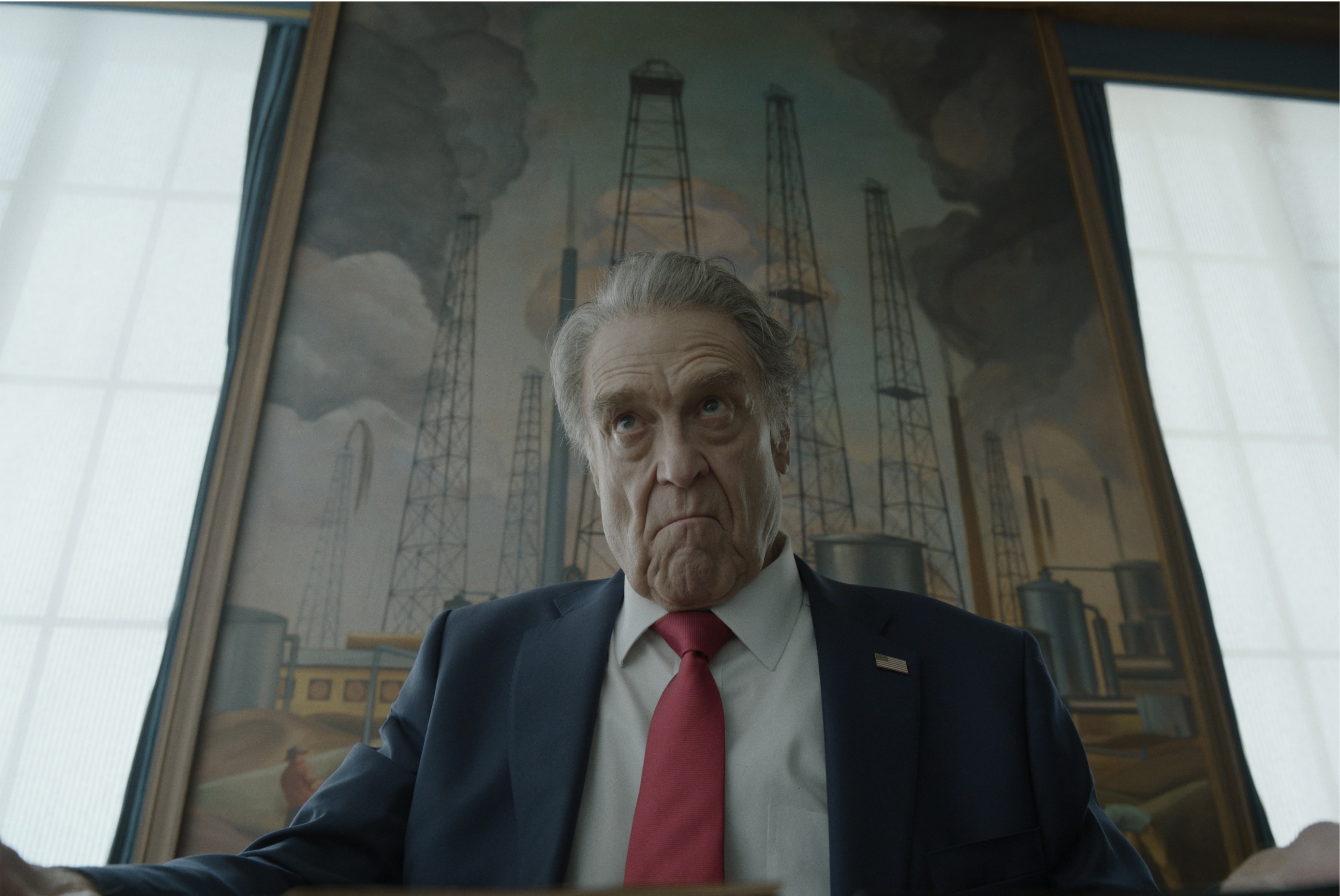
Director: Alejandro G. Iñárritu
Country: US
Writers: Sabina Berman, Jez Butterworth, Alexander Dinelaris
Actors: Tom Cruise, Riz Ahmed, John Goodman
Written by Tom Augustine
A histrionic film for histrionic times, the provocative, cumbersome Digger finds its maximalist director uncommonly focused, aided by a volcanic Tom Cruise in one of the year’s best performances. Iñárritu’s indulgent style is well-suited to a toothy satire less desperate for approval than his previous, Oscar-baiting efforts.
Like a lot of people, the end of the world has been front of mind for me in recent times. The United Nations have conceded that the time in which we could stop the event horizon of the 1.5°C global warming threshold has now passed, and that it is an inevitability, along with the ecological and human disasters surely to come. Artificial Intelligence conmen have sounded the alarm about their own technology’s potential to destroy humankind, in a ploy that many have read as just another attempt to shore up the parasitic, global warming-escalating tech phenomenon’s presence in daily life. Then, of course, there are the fascists, flooding governments across the world. Word is Nigel Farage could be the next Prime Minister in Downing Street. These are bleak times, indeed. I haven’t been thinking about ‘apocalypse’, that cinematic notion of a fiery end to existence, but instead the metaphor of a frog in a pot, the temperature slowly rising, unaware that they’ve found themselves in a deadly situation before it’s too late. It isn’t a direct one-to-one with our situation, though: we’ve known about the threats of climate change for decades. We have historical record, events that happened within the lifespans of people still with us, to warn us about what a fascist does, thinks and acts like. People use ChatGPT every day. We just haven’t done anything about it. If we’re frogs, we’re refusing to jump out of water we know is boiling because we’re scared, or complacently in denial, of what waits beyond the confines of our prison. That is to say, we’re suicidal.
The notion that the world won’t end, in a traditional narrative sense, but that it will simply go on, existence getting worse and worse forever, is one that frightens more than the somewhat-comforting notion that suffering can’t last, that at the very least, the sweet release of death awaits. It’s a notion at play in Digger, Alejandro G. Iñárritu’s unpleasant, uncomfortable new film, a picture of enormous anger — but to describe the way said notion appears in the film’s final frames counts as an iceberg-sized spoiler. Suffice to say it is about as unpalatable and bitter an ending as I can imagine, one that filled me with misery in a way that I registered as productive. Iñárritu’s ‘end’ isn’t so much logical as preordained — as one suicidal character offered in First Reformed, still the best and most prophetic film ever made about climate change, ‘you will live to see this’. If madness is doing the same thing over and over and expecting a different result, then we’ve all gone off the deep end, and the small handful of people who are ultimately responsible for these forthcoming catastrophes are as backed into a corner as the rest of us, conscious that the disorder that their actions will create is the only real way for them to stay afloat. Naomi Klein and Astra Taylor, in their new book, describe this as ‘End Times Fascism’: ‘They’re united in their belief that some kind of cleansing cataclysm is coming, and they welcome a future of shocks, scarcity and collapse, convinced they’ll be among the saved on the other side,’ reads the blurb. Digger Rockwell, Tom Cruise’s cartoonish Texas oilman, is one of these End Times Fascists.
There are elements to Digger that it doesn’t feel right to reveal here. Suffice to say that what is shown in the trailers is only a part of the story. Said story begins like this: Digger Rockwell, Texas oil tycoon, discovers that his drilling efforts in a nature reserve in Greenland have caused an iceberg five times the size of Washington D.C. to break away from the mainland, on a collision course with Europe. As well as that, the drilling has unleashed staggering levels of deadly methane buried in the earth, accelerating the destruction we’re already seeing. With mere hours to find a solution, Digger is brought in for questioning by a sickly US President (John Goodman) and his fawning, Christian nationalist cabinet, all the while battling ideologically with the put-upon scientist (Riz Ahmed) who discovered the initial cataclysm. This bubbles merrily along until the end of the first act, when a reveal morphs the film in a way that made me think of Bergman’s Persona, among other, similar works of structural and experimental daring.
I don’t know that I’ve seen a film like Digger, at this scale, with this level of provocation, in my lifetime. The closest comparison is also the least flattering — Adam McKay’s woeful Don’t Look Up, a film far easier for the addled and wearied masses to embrace, its provocations waterier and more reassuring (death comes in Don’t Look Up, with a self-satisfied smirk). Digger is an antagonistic film, one that wants you against it, urges you to hate it, as it hates itself. It’s an interesting move for Iñárritu, whose work has always been grandiose and overcooked in a way that served as catnip for awards bodies, but was fraudulent and masturbatory. His most ludicrously overpraised works, The Revenant and Birdman, wield their pomposity like a badge of honour, demanding to be taken seriously and removing any chance of the same in one fell swoop. To be clear, Digger is working in the same mould, but the maximalism here feels focused to a sharp point — it is a film less concerned with earning the affection of a bewildered audience, and more focused on its director’s howl into the void. That makes for a film that is unwieldy, frequently annoying: all the better to reflect the histrionic times in which we live.
Into this void steps Cruise, in a performance that is certainly among the top tier of a long and varied career. What a bizarre and commendable choice it is to opt for this role, in this film, as the world’s biggest and most apolitical movie star. Digger is a film that instinctively knows that decades of action films with ‘A Tom Cruise Movie’ splayed across the opening titles have ensured that few people see the characters he plays so much as they see the star himself. He himself has played into that: he’s cultivated an air of unknowability in his personal life to more easily align his movie star persona to our total understanding of the man. There was a time, though, before that was the case, and from that we got Magnolia, Eyes Wide Shut, Collateral and Born on the Fourth of July. It is a joy to see Cruise digging into Digger Rockwell with the relish with which he attacked those roles, even as Digger works to undermine and deconstruct the ‘Tom Cruise’ of it all in canny and fascinating ways. It also hearkens back to an era of a more political and outspoken movie star — how else to explain Born on the Fourth of July? This is a film that is unflattering in the most severe sense to people Cruise undoubtedly rubs shoulders with, a role whose cartoonishness conjures the spirits of real, maniacal billionaires like Musk, Bezos, Zuckerberg and the rest, and damns them unequivocally.
The result is a film whose imperfections and bracing cynicism all but beg to be misinterpreted. Digger is an exhausting picture, one that bears a close resemblance to Birdman in its ad nauseum sequences of yelling, overacting and slapdash attempts at comedy. Some of the supporting cast fare better than others — Ahmed is the film’s standout, though I also was taken by a mysterious Jesse Plemons in a role best left undisclosed — and much of Iñárritu’s attempts at lightheartedness fall flat. I concede the film’s flaws, and understand that Iñárritu’s platitudes will turn to ash in the mouths of many: though not as smug as a less artistically impressive Don’t Look Up, it is plenty smug. That the film openly courts comparison to masterworks by Kubrick and Roy Andersson does it no favours (though as an avowed Andersson fan, the film’s anchor sequence, in which Digger delivers a passionate monologue to a howling arena of pale, washed-out politicians, was my specific brand of catnip). The idea that films spouting humanistic ideals don’t change the hearts of people watching them is hardly new, and yet the film presents this idea as if it is. The pointlessness of it all is part of the film’s schema — that means that we’re watching a pointless film that delights in highlighting how pointless it is. And yet. There is something to Iñárritu and Cruise knowing this and opting to do it anyway, to put these resources to a work that says what we all know but which rarely gets a platform such as this. For once, Iñárritu doesn’t position himself above his audience. Along the way, Digger reckons with the idea of who gets to make art, why we make art, and who ultimately benefits from it. The findings of these inquiries are as devoutly hopeless as everything else in the picture.
Digger – Now In Cinemas.